
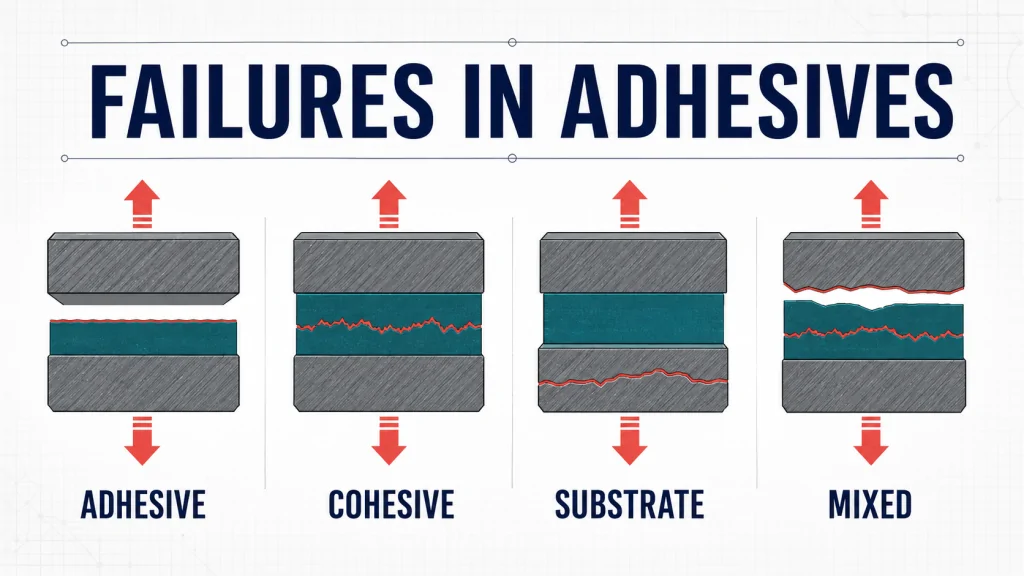
Failures in adhesives refer to the loss of bond integrity between two joined surfaces. An adhesive failure can compromise both the structural strength and the functional performance of an assembly. Understanding the way a bond fails is the first step toward identifying the cause and preventing the problem from recurring.
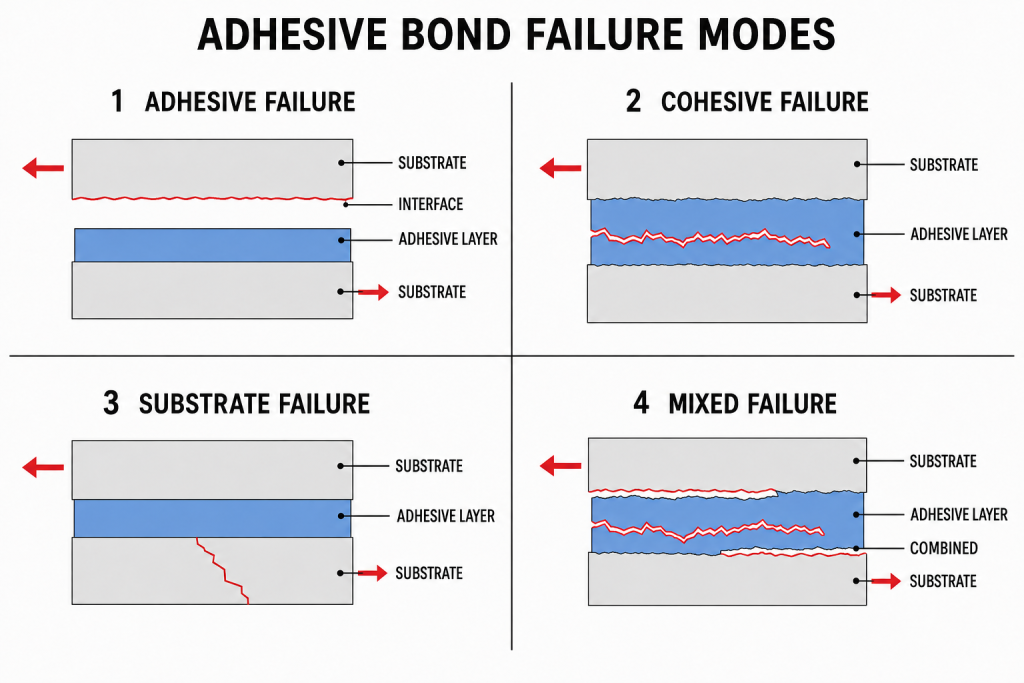
Adhesive Failure
Adhesive failure occurs when separation develops at the interface between the adhesive and one of the joined surfaces. It often indicates insufficient adhesion caused by contamination, poor surface preparation, or an unsuitable adhesive.
Cohesive Failure
Cohesive failure occurs when the separation takes place within the adhesive layer itself. In this case, adhesive remains visible on both substrates, while the internal strength of the cured adhesive has been exceeded.
Substrate Failure
Substrate failure occurs when one of the joined materials cracks, tears, or breaks before the adhesive bond fails. This generally means that the bond is stronger than the substrate itself.
Mixed Failure
Mixed failure combines two or more failure modes within the same bonded area. For example, part of the bond may fail at the interface while another section fails cohesively within the adhesive.
Why Do Adhesive Failures Occur?
Adhesive bond failures can develop for several reasons. The most important causes are environmental exposure, mechanical stress, ageing, fatigue, and process-related errors.
Environmental Conditions
Abrupt temperature changes, prolonged exposure to extremely high or low temperatures, moisture, chemicals, and ultraviolet radiation can damage the internal structure of an adhesive and weaken its bond with the substrates.
Mechanical Conditions
Vibration and excessive shear, peel, cleavage, or tensile forces can exceed the resistance limit of the bond. Repeated loading can also create microscopic damage that grows over time.
Ageing and Fatigue
Continuous use of a bonded component can gradually reduce bond performance. Cyclic loading, thermal cycling, and long-term environmental exposure may eventually produce adhesive failure even when the original assembly was properly designed.
Process Errors
Using an incorrect mixing ratio, applying too much or too little adhesive, exceeding the working time, or curing under unsuitable conditions can prevent the bond from reaching its intended strength.
Factors That Cause Failures in Adhesives
The most common practical causes of adhesive failure can be categorised as follows:
Improper Surface Preparation
Dust, oil, moisture, rust, release agents, and residues from previous processes can prevent successful bonding. The adhesive may bond to the contaminant layer instead of the actual substrate surface.
Wrong Choice of Adhesive
Not every adhesive is compatible with every material or service condition. The correct adhesive must suit the substrates, operating temperature, expected loads, chemical exposure, and required production process.
Inadequate Curing Process
Incomplete curing or the use of incorrect curing conditions prevents an adhesive from achieving its optimal physical and mechanical properties. Temperature, time, humidity, and mixing accuracy should follow the product specifications.
Structural Flaws
Surface defects, impurities, poor joint geometry, and design flaws can create gaps or stress concentrations within the assembly. These localised stresses may initiate cracks and accelerate bond failure.
How to Avoid Failures in Adhesives
Although some long-term effects of ageing and use cannot be eliminated completely, several measures can significantly reduce the risk of adhesive failure:
- Clean and prepare every surface thoroughly to achieve optimal adhesion.
- Select an adhesive that is compatible with the substrates and capable of resisting the assembly’s environmental and mechanical conditions.
- Follow the recommended mixing, application, working-time, and curing procedures.
- Design the joint to distribute loads evenly and minimise peel or cleavage stress.
- Validate the complete bonding process with representative samples and appropriate testing.
Adhetron
Adhetron products are designed for a wide range of external and internal conditions. Our portfolio supports different industries, manufacturing processes, substrates, and performance requirements. If you are unsure which Adhetron product is best suited to your manufacturing process, contact us. Our experts will help you identify the right adhesive solution for your application.